
- Details

MERWEVILLE HISTORY

The small village of Merweville lies in the area of the Great Karoo known as the Koup. It is an arid area with an average rainfall of 150mm.
The Beaufort West Parish of the Dutch Reformed Church, during the 1800s served a geographic area in excess of 30,000 square kilometers. In order to attend “nagmaal” or communion the local residents and their families would need to travel more than 120-kilometres to Beaufort West.
In 1897, with the support of the Dutch Reformed Church Reverend in Beaufort West, Pieter van der Merwe, the local farmers appealed to the church authorities to create a new parish. An offer was made to purchase a portion of the farm Vanderbylskraal from its owner, Johannes Jacobus Le Seur van der Byl. The sale was concluded for the sum of £4,500 and from this transaction the village of Merweville was born and named in honour of Reverend van der Merwe from Beaufort West.
The outbreak of the Anglo Boer War in 1899 interrupted the establishment and development of the village and it was only in 1905 that the land was transferred to the church and the village was formally established.
In the early days most of the economic activity in town centered around the homestead of van der Byl. In addition to houses and cottages surrounding the main house, there were store rooms, stables, sheds, a shop and post office. The farm often hosted post coach passengers. There was also a small police station and a jail. As the locally appointed magistrate, Van der Byl heard cases on petty offences and infringements of the law. He imposed fines, punishments and short-term sentences which were served in the farm jail.
There are four access roads into the town and the 44km road, which was upgraded in 2015, from the N1 at Prins Albert Road is beautifully tarred and pothole free. The others are gravel roads that are generally in a good condition. Due to Merweville being off the fast moving beaten track it has been possible to maintain a jealousy guarded old world charm and pace. Here the businesses still close for lunch!
Visitors to the town may be surprised by the lack of street lights, that is by design, when the residents, in 1998 when the Eskom power was laid on, chose to not have streetlights.
Today the mainly sheep farming community is the backbone of the town’s economy. Most if not all of the business in town interact with farmers and their workers on a regular basis. The most common farming activity is sheep and here they farm with Dorpers, a pure South African breed, and Meat Masters. Other animal farming activities are Goat and Game. Onion, Lucerne, Oranges and Olives are also cultivated. With the unfortunate but well known drought cycles farmers need to diversify to endure in this harsh farming environment. They have learnt to work with nature and not against it.
Change comes slow to Merweville, a town where the silence is audible and the air fresh.
The less than 2000 residents cherish and treasure their lifestyle.
- Details
LETTERKOP
“MERWEVILLE 1904" is volgens oorlewering met die stigting van die dorp uitgepak. Die letters is later vergroot soos wat dit vandag daar uitsien. In 2002, met die oprigting van die selfoontoring, is die pad sodanig verbeter dat dit meer toeganklik is vir inwoners en besoekers. Die sonsondergang van daarbo is asemrowend.
“WELKOM” is in 1918 deur F. Mocke aan die noordoostekant van die gruiskop met klippe gepak en wit gekalk. Hierdie was gedoen vir die eerste Ringsitting te Merweville, wat weens reën, nooit plaasgevind het nie.
“JESUS LEEF” is in 1998 met die besoek van die Diensjaarspan uitgepak.
DIE KRUIS op die hange van Letterkop is deur ds Lourens van Vuuren, Johan Marais en Antonie (Hans) Botes opgerig. Die beligting van die kruis is moontlik gemaak deur Pieter van der Bijl, agterkleinseun van die oorspronklike eienaar van Van der Bijlskraal. Ongelukkig is die kragkabel gesteel en is dit saans nie meer sigbaar nie.
“WELKOM” is ook op die suidekant van die kop uitgepak. Inligting word nagevors.


- Details
ENGLISHMAN’S GRAVE
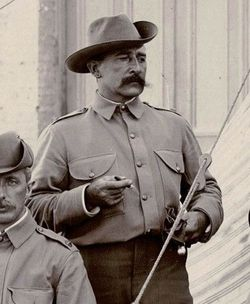
Photo Source: www.vwma.org.au
Lt Walter Oliphant Arnot
- Born: 01September 1860, Harwich, Essex, England
- Died 15 April 1902 (Headstone shows 16th)
- War: Boer War 1899 - 1902
- Grave: Merweville, Western Cape, South Africa
- Last Unit: 3rd South Australian Bushmen's Contingent
- Award: Walter Oliphant ARNOT Queen's Medal with clasps
Source: www.vwma.org.au
CONTEXT
Why is it called the Engelsman se Graf (Englishman’s Grave”)?
It is fully understood that Lt Arnot was an Australian. However, within the Afrikaans community all English-speaking people are often grouped under the banner of Englishman, irrespective of their heritage. Even more so in the early 1900’s when very few spoke and or understood English.
Why did the people agree and commit to look after the grave of Lt Arnot?
The real reason and motivation has been lost over time and looking back it seems strange as to why they would do anything for an Englishman. It is unlikely that the conservative Afrikaners of that time, who actually hated the British for their Scorched Earth policy of the British commander Lord Kitchener, would want anything to do with an Englishman in general, let alone an Englishman’s grave? The one story is that he was spying for the Boers, however the suicide note left by Lt Arnot refutes this. The other scenario could be that Lt Arnot’s alleged sympathetic support of the Boers was true and that, in this way, they acknowledged that. The latter scenario seems the most likely but remains speculation.
2026
Late September, a small ceremony is planned at the grave to honor a fallen soldier and reaffirm the town's undertaking.
2024
Grave Access
During the year the Vroue Landbouvereniging (Women's Agricultural Association) launched a project to improve the access to the Englishman's Grave.
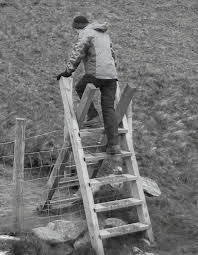
One of the farmers brought his team and built a stone stairway to provide easier access from the road level down to the fence. They also installed a sturdy handrail. In the past you needed to climb over via a rickety pole ladder, similar to the one below.
They removed the rickety ladder and built a gate opening in the fence. The pathway to the grave was also maintained and it is now an easy short walk to the gravesite.
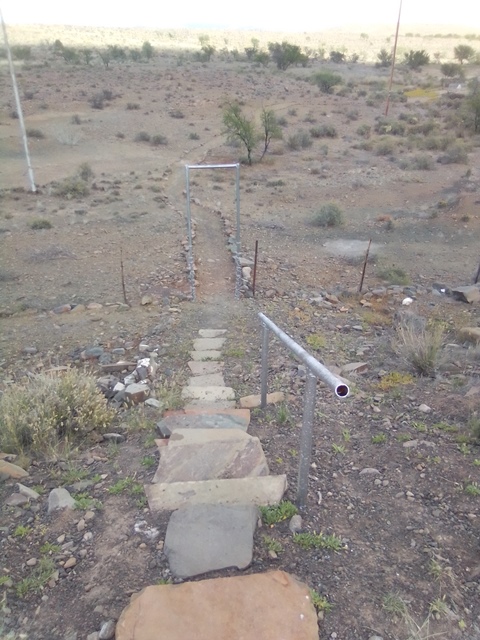
Thereafter, one of the town residents painted the new railing and gate as well as a fresh coat of paint on the grave ironwork railing.
Over the years many farmers and or residents and even visitors to the town, have contributed in many ways to maintain the gravesite.
2004
Grave Restoration
As part of the NG Church's centenary celebrations, a number of projects were undertaken. The clean-up and restoration off the Englishman's Grave being one of them.
The grave headstone had been vandalised and the cross broken off. A community member sponsored the cost of a black granite cross. It was decided to place the cross flat on the ground in front of the original headstone base. Small reddish-brown stones were collected on the farm Kareehoek and packed on top of the grave. The iron railing was also repaired by one of the farmers.
The veld had started reclaiming the area and the growth was also removed from around the grave.
Lt WO Arnot History
The Englishman's Grave lies in a secluded spot just outside Merweville on the road to Prince Albert Road. Walter Arnot was the son of Dr Henry Arnot, MD RN. Lt Arnot was born 9 September 1860 in Essex, England. He was educated at the Royal Naval School in New Cross, London. At the age of nineteen he moved to Australia to take up sheep farming and by the age of 20 was managing a large sheep station.
During the next eight years he held similar positions on other major sheep stations and was complemented on his stock management practices during a long drought. In 1888 he joined A Battery Field Artillery in Adelaide and was married in the same year. When the Anglo Boer war broke out in 1899 he joined the 3rd South Australian Contingent - the South Australia Bushmen Corps, as a sergeant. The Corps specialised in scouting and intelligence gathering. He arrived in Africa at the port of Beira in Portuguese East Africa and was promoted to lieutenant.
In April 1902 Lieutenant Arnot found himself in the Laingsburg district and was engaged in a scouting patrol. He was accompanied by Private John Sparkes, of the 16th Lancers, who was stationed at Laingsburg and in charge of the Intelligence Department's horse unit and Abraham January, a scout and resident of Laingsburg. The patrol spent the first night at Blaaubank farm and rode on to Dwars River farm, near Sutherland, to interview Jacobus Adriaan Victor, the only person in the district who spoke English.
At the inquest Victor said Arnot had been in "good spirits and quite jolly". But soon after that his mood seemed to change. He sank into a deep depression as the patrol rode via Modderfontein, De Zyfer and Van Wyksberg farms to Prince Albert Road. By the 15th of April, as Jacob stated at the inquest, "Arnot was not in his usual mood. He was very quiet and withdrawn."
Just outside the tiny village of Merweville he took his rifle and a cartridge and walked towards a small hill. His companions thought he was going to shoot a bird as he had done before. Suddenly Abraham January shouted: "He's going to shoot himself!" Before they could reach him, he pulled the trigger. The inquest found he had died from a self-inflicted gunshot wound "while in a state of temporary derangement."
IN MEMORY
Lt Arnot's wife funded and arranged for the grave headstone and the iron railing around the grave. The community undertook to look after the grave. To this day the town of Merweville has kept their promise and the grave is regularly maintained.
Look out for the “Engelsman se Graf” signboard as you leave the town towards Prins Albert Road. There are a few steps down from the road and then an easy 100m walk on a cleared path to the grave.
DECENDANTS
Lt Arnot's wife was Eleanor Frederica Rosevear (née Seabrook) Arnot of 100 Esmond Road, Bedford Park, London. She passed away in 1911.
They had four children:
- Gladys Lavinia Florence - Born1889 - Deceased
- Douglas Henry Walter Born 1891- Deceased 1969
- Laurion Anthony Deane Arnot Born 1894. 2nd Lieutenant, 2nd Battalion Gordon Highlanders, was killed in action on the 25th of September 1915. He is commemorated on the Tyne Cot Memorial, Panels 72 to 75.
- Colin Arnot born in 1897. 1st Battalion attached to B Company, 2/5th Battalion Gloucestershire Regiment. Killed in action on the 22nd of March 1918, aged 21
Source: www.vwma.org.au

Photographer: Unknown

Photo: Leon le Roux
Article Updated: 10 August 2026
For more photos Click on the button below

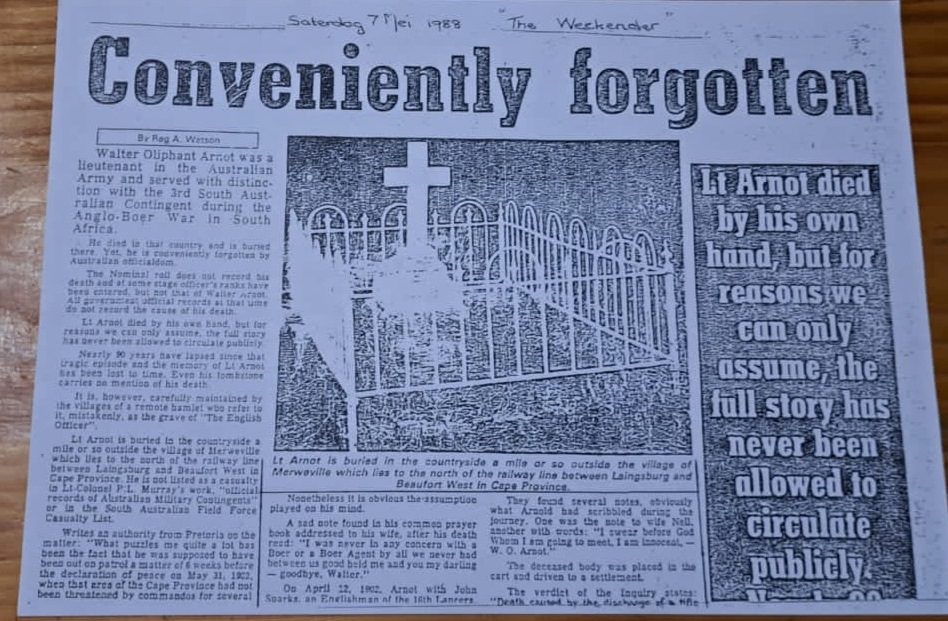
CONVENIENTLY FORGOTTEN
Newspaper Article Heading: Conveniently Forgotten
Author: Br Reg A Watson
Published Date: 7 May 1988
Newspaper Published: The Advocate, Tasmania, also known by the locals as The Weekender,
Walter Oliphant Arnot was a lieutenant in the Australian Army and served with the 3rd South Australian Contingent during the Anglo Boer war in South Africa.
He died in that country and buried there. Yet he is conveniently forgotten by Australian Officialdom.
The Nominal Roll does not record his death and at some stage some officer rank has been entered, but not that of Walter Arnot. All government official records at the time do not record the cause of his death.
Lt Arnot died by his own hand, but for reasons we can only assume, the full story has never been allowed to circulate publically.
Nearly 90 years have lapsed since that tragic episode and the memory of Lt Arnot has been lost over time. Even his tombstone carries no mention of his death.
It is, however, carefully maintained by the villagers of a remote hamlet who refers to it, mistakenly, at the grave of “The English Officer”
Lt Arnot is buried in the countryside a mile or so outside the village of Merweville which lies to the north of the railway line between Laingsburg and Beaufort West, Cape Colony. He is not listed as a casualty in Lt Col PI Murray’s work, “Official record of Australian Military Contingent” or in the South Australian Field Force casualty list.
Writes as authority from Pretoria on the matter: “What puzzles me quite a lot has been the fact that he was supposed to have been out on patrol a matter of 6 weeks before the declaration of peace on May 31, 1902, when that area of the Cape Province had not been threatened by Commandos for several (months?)”
Nonetheless it is obvious the assumption played on his mind.
A sad note found in his common prayer book addressed to his wife, after his death read: “I was never in any concern with a Boer or a Boer Agent by all we never had between us good held me and you my darling – goodbye, Walter.”
On April 12, 1902 Arnot with John Soarks, an Englishman of the 16th Lancers (article cut off)
They found several notes obviously what Arnot had scribbled during the journey. One was the note to his wife Nell, another with words “I swear before God Whom I am going to meet, I am innocent. – W O Arnot.
The deceased body was placed in the cart and driven to a settlement.
The verdict of the Inquiry states “Death by the discharge of a rifle”
NOTE
Article transcribed from the photo of the newspaper article, as accurately as could be. Any transcription errors are unintentional and regretted.
An official transcription of the article has been requested from www.regwatson.com. Should this be successful, the transcription will be updated to the official record – Leon le Roux
20 August 2026